
By the Victech Solutions team · Last updated: November 2026 · 9 min read
monday CRM vs HubSpot is a harder choice than it looks. Both are popular, both have great reviews, and both promise to fix your sales process. But they were built for different jobs, and picking the wrong one usually shows up a few months later as a bigger bill or a CRM nobody updates.
The short answer: monday CRM is usually the better fit when you want sales and project delivery in one flexible workspace. HubSpot is usually the better fit when marketing drives your leads and you want email, forms and lead scoring built in. If you are an agency or service business that runs on funnels, booking calls and SMS follow-ups, GoHighLevel is worth a look too.
We set up CRM systems in monday CRM, HubSpot and GoHighLevel for agencies, coaches, SaaS teams and service businesses in the US, UK and Australia. This comparison is based on that hands-on work, plus current pricing and review data.
Table of Contents
monday CRM vs HubSpot: quick verdict
| Feature | monday CRM | HubSpot CRM | GoHighLevel |
|---|---|---|---|
| Best for | Teams that want sales and delivery in one flexible workspace | Teams where marketing and sales work closely together | Agencies and local service businesses running funnels and SMS |
| Starting price | $12 per seat a month, 3-seat minimum | Free CRM, paid plans per seat | $97 a month, flat |
| Pricing model | Per seat | Per seat plus hub tiers | Flat monthly fee |
| Ease of use | Very easy, visual boards | Easy to start, grows complex | Powerful but busy |
| Customization | Very high | Medium, more structured | High for marketing flows |
| Marketing tools | Basic | Very strong | Strong, with SMS and funnels |
| G2 rating (Nov 2026) | 4.5 / 5 | 4.4 / 5 | 4.6 / 5 |
What is monday CRM and who is it for?
monday CRM runs on the same platform as monday.com Work Management. That is its biggest strength. Deals, contacts and accounts live on boards, and when a deal is won it can flow straight into a delivery board, with owners assigned and tasks created automatically.
It suits teams that want one place for leads, deals, onboarding and projects, and teams whose process does not fit a standard sales template.
Pros
- Very easy for teams to pick up
- Highly customizable boards, stages and views
- Sales and project delivery in one workspace
- Flexible dashboards that pull from any board
Cons
- No free plan, and a 3-seat minimum
- Seats are sold in blocks, so a team of 6 pays for 10
- The Basic plan has no automations or integrations
- Marketing tools are basic compared with HubSpot
What is HubSpot CRM and who is it for?
HubSpot started as a marketing platform and grew into a full CRM. Its free CRM is genuinely useful for small teams, and paid hubs add sales, marketing and service tools on top.
It suits teams where marketing and sales work closely: website forms, email campaigns, lead scoring, sequences and clear reporting on where every lead came from.
Pros
- A free CRM to start with
- Strong marketing, email and lead scoring tools
- Excellent built-in reports and attribution
- Huge app marketplace and learning resources
Cons
- Big price jump from Starter to Professional
- Mandatory one-time onboarding fee on Professional and Enterprise
- Less flexible when your process is unusual
- Can feel heavy for very small teams
Where does GoHighLevel fit?
GoHighLevel is built for agencies and local service businesses. It combines a CRM pipeline with funnels, landing pages, calendars, SMS and email follow-ups, and lets agencies run separate accounts for each client.
Pricing is flat rather than per seat: Starter is $97 a month, Unlimited $297 and Agency Pro $497. Paying yearly ($970, $2,970 or $4,970) gives you roughly two months free. There is no free plan, only a 14-day trial, and phone, SMS and email sending are charged on usage on top of the plan.
If your business lives on booking calls and fast follow-up by text, GoHighLevel can replace several tools at once. If you mainly need a clean pipeline connected to delivery or strong inbound marketing, monday CRM or HubSpot will usually feel simpler.
monday CRM vs HubSpot: feature by feature
Pipelines and deals
Both handle deal pipelines well. monday CRM lets you shape stages, columns and views however you like, and link deals to accounts and projects. HubSpot uses a fixed structure of contacts, companies and deals, which keeps data tidy but gives you less freedom.
Automation and follow-ups
monday CRM uses simple “when this happens, do that” recipes, such as assigning an owner, sending a reminder or moving a won deal into delivery. Automations start from the Standard plan, and for more complex flows monday connects well with Make, Zapier and its own API. HubSpot’s workflows and sequences are stronger for email follow-up and nurturing, but most of them sit on the Professional tier.
Email and marketing
This is HubSpot’s home ground. Forms, landing pages, campaigns and lead scoring are built in. monday CRM covers sales emails and basic campaigns, but it is not a full marketing platform.
Reporting and dashboards
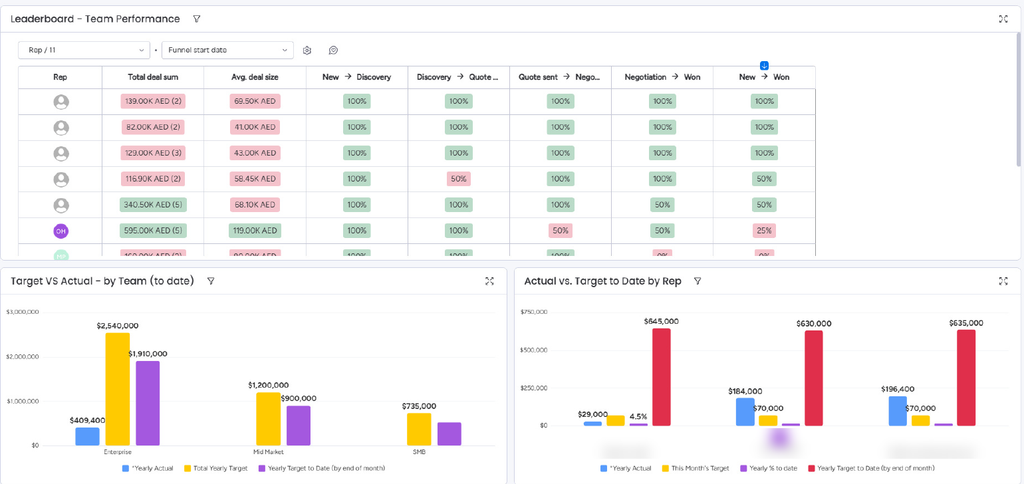
HubSpot has strong ready-made reports, especially for marketing attribution. monday CRM’s dashboards are more flexible and can show sales, delivery and workload side by side.
Ease of use and setup time
monday is one of the easiest tools for a team to adopt, because boards look like colourful spreadsheets. Setup takes a few days for a team new to monday, and less if the team already uses it for projects. HubSpot’s guided onboarding can get a small team running in about a day, but it has many menus and settings once you grow.
Price guide and hidden costs
This is where most comparisons stop too early. The price on the pricing page is rarely what you pay in year one.
monday CRM: Basic is $12, Standard $17 and Pro $28 per seat a month on annual billing. There is a 3-seat minimum, and seats are sold in blocks, so a team of four pays for five seats and a team of six pays for ten. Basic has no automations, so most sales teams need Standard or Pro.
HubSpot: the free CRM covers the basics for up to 2 users, and Sales Hub Starter costs from $9 per seat a month on annual billing. The jump comes at Professional, which is around $90 per seat a month on annual billing plus a mandatory one-time onboarding fee of $1,500. Professional is where sequences and fully customizable workflows live, so many growing teams end up there.
Real year-one cost for a 5-person team:
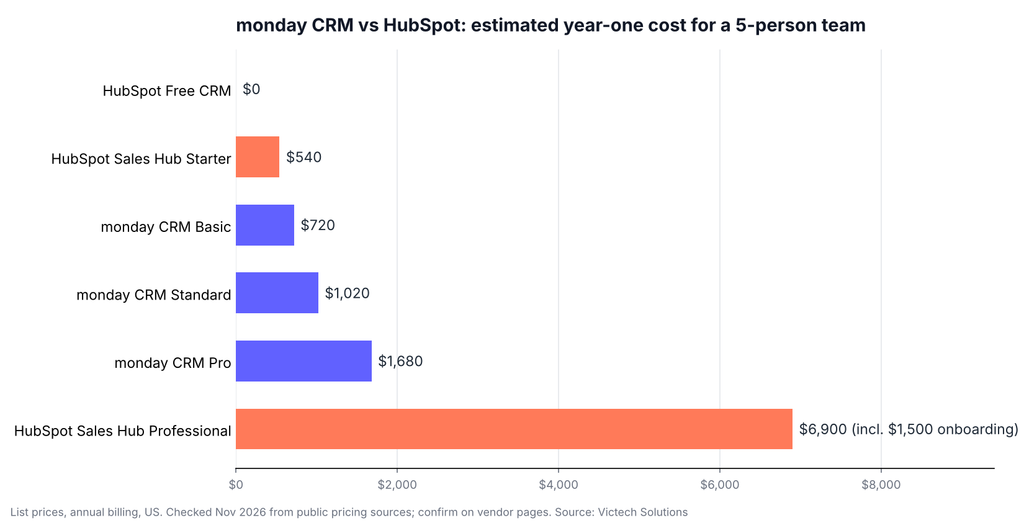
| Plan | Year-one cost, 5 users |
|---|---|
| HubSpot Free CRM | $0 |
| HubSpot Sales Hub Starter | about $540 |
| monday CRM Basic | $720 |
| monday CRM Standard | $1,020 |
| monday CRM Pro | $1,680 |
| HubSpot Sales Hub Professional | about $6,900 including onboarding |
The takeaway on monday CRM vs HubSpot pricing: HubSpot is cheapest at the very start and most expensive once you need its advanced sales automation. monday CRM sits in the middle and stays more predictable as you grow.
Integrations
Both connect with Gmail, Outlook, Slack, Zoom, Zapier and Make, and both have open APIs. HubSpot’s marketplace is larger. monday’s strength is that its CRM connects natively to monday Work Management, so sales and delivery share one platform.
Security
Both offer GDPR compliance, SOC 2 Type II, encryption in transit and at rest, single sign-on and two-factor authentication, with HIPAA options on enterprise plans.
HubSpot vs monday CRM: when to choose which
Choose monday CRM if you want sales and delivery in one place, your process is a bit different from the standard, your team needs something easy to adopt, and heavy marketing automation is not your main need.
Choose HubSpot if marketing drives your leads, you need forms, emails and lead scoring built in, you want strong attribution reports, or you want to start on a free plan.
Choose GoHighLevel if you are an agency or local service business that runs on funnels, booking calls and fast SMS and email follow-up.
Can you use monday and HubSpot together?
Yes, and many teams do. A common setup is HubSpot for marketing and lead capture, and monday for delivery. When a deal is won in HubSpot, a project with tasks and owners is created in monday automatically, and the project status can be shown back on the HubSpot record.
There are three ways to connect them:
- monday’s native HubSpot integration for simple syncing of leads, contacts and companies
- Zapier for ready-made triggers, such as creating a monday item when a deal reaches a stage
- Make or a custom API build when you need two-way sync, field mapping and error handling
One thing to watch: large bulk imports can hit API limits on both platforms, and some syncs fail quietly. Test with real data before you rely on it.
We have connected HubSpot with Slack and ClickUp for a SaaS team so records and stage changes moved between the tools without anyone copying data by hand. The same approach works between HubSpot and monday.
Our experience at Victech
After building systems in all three tools, the biggest lesson is simple: the best CRM is the one your team keeps updated. We regularly see teams paying for powerful plans while still tracking deals in spreadsheets, because the setup was too complicated for daily use.
Teams that also run projects tend to settle into monday CRM fastest, because sales and delivery finally live in one place. Teams whose leads come mostly from inbound marketing get more out of HubSpot’s built-in tools.
So before choosing, write down how a lead becomes a paying client in your business, step by step. If that journey ends in project delivery, monday CRM usually wins. If it starts with campaigns and email, HubSpot usually wins. If it runs on funnels and text messages, look at GoHighLevel.
FAQ
Is monday CRM better than HubSpot?
Neither is better for everyone. monday CRM is better for flexible sales and delivery in one place. HubSpot is better when marketing and sales automation matter most.
Which is cheaper for a small team, monday CRM or HubSpot?
HubSpot is cheaper at the start because of its free CRM and low-cost Starter plan. Once you need advanced automation, HubSpot Professional with its onboarding fee usually costs much more than monday CRM Standard or Pro.
Is HubSpot CRM really free?
Yes, the core CRM for contacts and deals is free. Most advanced automation, sequences and custom reporting are on paid plans.
Why does monday CRM require a minimum of 3 seats?
All paid monday CRM plans start at 3 seats, and larger teams buy seats in blocks. A solo user or a two-person team still pays for three seats.
Does HubSpot integrate with monday.com?
Yes. monday.com has a native HubSpot integration, and you can also connect them with Zapier or Make for more custom flows, such as creating a project in monday when a deal is won in HubSpot.
Which CRM is best for agencies: monday CRM, HubSpot or GoHighLevel?
Agencies that deliver client projects often prefer monday CRM. Agencies focused on lead generation for many small clients often prefer GoHighLevel. Agencies doing inbound marketing at scale often prefer HubSpot.
Need help choosing or setting it up?
If you are still unsure, send us a short note on how your team sells and delivers today. We will tell you which CRM fits and what it would take to set it up properly. Email support@victechsolutions.com or book a call through our contact page.
About Victech Solutions
Victech Solutions is a monday.com certified CRM and automation team. We build monday.com workspaces, CRM pipelines, dashboards and Make, n8n and Zapier automations for teams in the US, UK and Australia.